Ahuza Societies: How Diaspora Jews Bought Land Together
Ahuza societies were buying groups in which Jews in cities like St. Louis, New York and Winnipeg pooled instalments to buy land in Eretz Israel before settling.
Key points
- An Ahuza (also spelled Achooza or Achuza) was a buying company of Jews from one city who paid instalments so that land could be bought and planted for them in Eretz Israel.
- About 70 Ahuza companies were formed between 1908 and 1914, but only five Ahuza settlements were established before the First World War.
- The New York company Ahuzat New York A, formed in 1912, founded Ra'anana in 1922.
- Members were meant to stay at home until the trees bore fruit, so many paid in but never came, especially after war, crisis and the Holocaust intervened.
- Correspondence of several Ahuza companies survives in the Central Zionist Archives in Jerusalem.
An Ahuza (also written Achooza, Achuza or Ahuzat) was a buying company formed by Jews in one diaspora city. Members paid in instalments so that land in Eretz Israel could be bought and planted for them, and they planned to move there once the trees bore fruit. Ra'anana was founded in 1922 by one such company from New York. Many members, however, paid in and never came, and this is one source of family memories of "land back home".
This guide explains how the Ahuza system worked, which groups are documented, why so many members stayed abroad, and where records may survive.
What was an Ahuza society?
The historian Yossi Katz, who has studied the movement in depth, translates the Hebrew name as "ownership of private land" and notes that it is taken from the Book of Numbers (32:22). The system differed from the two main forms of settlement at the time:
- National capital. The Jewish National Fund bought land with donations from the Jewish people.
- Philanthropic capital. Settlement was funded by Baron Rothschild.
An Ahuza ran on private capital. In Katz's words, its aim was to let middle-class Jews from around the world settle in Eretz Israel.
Katz describes the problems it was meant to solve. Earlier middle-class immigrants who tried to buy land on their own struggled with unfamiliar Turkish (Ottoman) land laws, under which only Turkish citizens could buy land, and with speculators who pushed up prices. Few had any farming experience, and many gave up and returned home or moved to the cities.
How did membership and plots work?
Katz reconstructed the system from company correspondence held in the Central Zionist Archives. The core rules were these:
- One city, one company. Members of each company came from the same city, so that they would know one another before settling together.
- Instalments over years. Members paid into a company fund in instalments over a period of about ten years, while carrying on their businesses at home.
- Purchase through a Zionist agency. Land was bought and worked together with the Palestine Land Development Company, founded in 1908 by the Zionist Organization and led by Arthur Ruppin.
- Planting before settling. Local Jewish workers prepared and planted the land, usually with olives and almonds, which take six to ten years to bear fruit.
- Plots divided only on arrival. The land was held and worked jointly. It was divided into individual plots only when the members came to settle.
An example: the Winnipeg company's rules
The Winnipeg company, founded in November 1912 as "Ho'achoozo — The Palestine Land Company of Winnipeg", set out its rules in detail. Its funds were to be held at the Anglo-Palestine Company, the bank of the Zionist Organization, and the land bought only through the Palestine Land Development Company. The membership terms were:
| Term | Rule |
|---|---|
| Price of membership | 7 shares at $200 each, a total of $1,400 |
| Payment | Instalments of $140 a year over 10 years |
| What a full member would receive | 70 dunams: 64 planted with olives and almonds, 6 for a house, garden and equipment |
| How plots were assigned | By lot, after 10 years, when members came to settle |
| Public land | 4% set aside for public buildings before division |
(A dunam is about 1,000 square metres, roughly a quarter of an acre.)
Families should note the final point. In this model, a member who never arrived may never have had a separate plot in his own name. What he held was a share in a company and a claim on land held jointly.
How many Ahuza companies were there, and where?
Katz counts about 70 Ahuza companies formed between 1908 and 1914. Just before the First World War there were:
- 49 in Russia and Eastern Europe
- 14 in the United States
- 3 in Canada (Winnipeg in 1912, Toronto and Montreal in 1914)
- 2 in England
- 1 in France
- 1 in Argentina
The first was founded in St. Louis in October 1908 by Shimon Goldman. Two companies followed in New York in 1909, one in Chicago in 1911, a second in St. Louis in 1912 and another in New York the same year.
Despite the number of companies, Katz records only five Ahuza settlements founded before the war:
- Poriya, by Jews of St. Louis
- Ruhama (1912), by Jews of Moscow
- a settlement founded in 1912 by Jews of Chicago
- Kfar Uriya (1913), by Jews of Bialystok
- Karkur (1914), by Jews of London
Encyclopaedia Judaica describes Poriya as a fruit farm, mainly almond plantations, founded by American Zionists. A few of them came to settle, and the site was abandoned during the First World War.
Ahuza A – New York and the founding of Ra'anana
The best-known Ahuza story is Ra'anana's. According to Encyclopaedia Judaica, Ra'anana was established in 1922 as a moshava by a group of American Jews of Ahuzat New York A Inc., a company formed in 1912. The land was bought through the Palestine Land Development Company. Early settlers faced economic hardship and tried cattle farming. Citrus growing took hold in the late 1920s and 1930s, once groundwater had been reached.
The company kept growing after Ra'anana was founded. In October 1930 the JTA reported that the New York Achooza Aleph had bought about 6,000 dunams around Yavneh, bringing its holdings to about 25,000 dunams. The holdings already included the American colonies of Ra'anana and Tel Ranan. The company had an investment of over a million dollars in Palestine and had recently set up a bank to help individual settlers. Rabbi Issachar Levin of Trenton, New Jersey, was re-elected president.
Because so many early residents were English-speaking Americans, Ra'anana was once known as "Little America".
Why did so many members never come?
The plan assumed that members would stay at home for years before settling, so many never left. Several things kept them abroad:
- The First World War. Katz writes that the war cut Palestine off from Europe and America and halted land purchases. He also notes that the American companies stopped their instalments because the country's future looked uncertain.
- Companies that never bought land. Many companies, especially in Eastern Europe, could not raise enough money and dissolved. The Winnipeg company raised about $13,000 but never completed a purchase. Its members voted in 1922 to dissolve it and divide the money among themselves.
- Long waits and changing lives. Trees took up to a decade to bear fruit. In that time members' families, businesses and plans changed.
- Land held as a sentimental investment. In 1935 the president of the American Zion Commonwealth, a separate land company, said that many American Zionists had bought land largely for sentimental reasons but could not live there.
- The Holocaust. For buyers in Poland and elsewhere in Europe, the Holocaust ended any plan to settle. The Afula municipality notes, for example, that many Polish Jews who bought land in Afula perished in it.
The result was a generation of families in New York, St. Louis, Chicago, Winnipeg, London and Eastern Europe who had paid towards land in Eretz Israel. They kept certificates, receipts and stories, and some never learned what became of the land.
How did Ahuza societies differ from land companies?
Ahuza groups were not the only way diaspora Jews bought land. In the 1920s, the American Zion Commonwealth sold plots in Herzliya, Afula and Balfouria directly to individual buyers in America and Poland. The two models are easy to confuse:
| Ahuza society | American Zion Commonwealth | |
|---|---|---|
| Who bought | A group from one city, acting together | Individual buyers |
| Main period | 1908–1914 (Ra'anana's company continued into the 1930s) | The 1920s |
| What the member held | Shares and a future plot, often divided on arrival | A contract or certificate for a plot |
| Typical places | Poriya, Karkur, Ra'anana and others | Herzliya, Afula, Balfouria |
Our guide to the American Zion Commonwealth's land purchases covers that company in detail.
Ahuzat Bayit: a different kind of "ahuza"
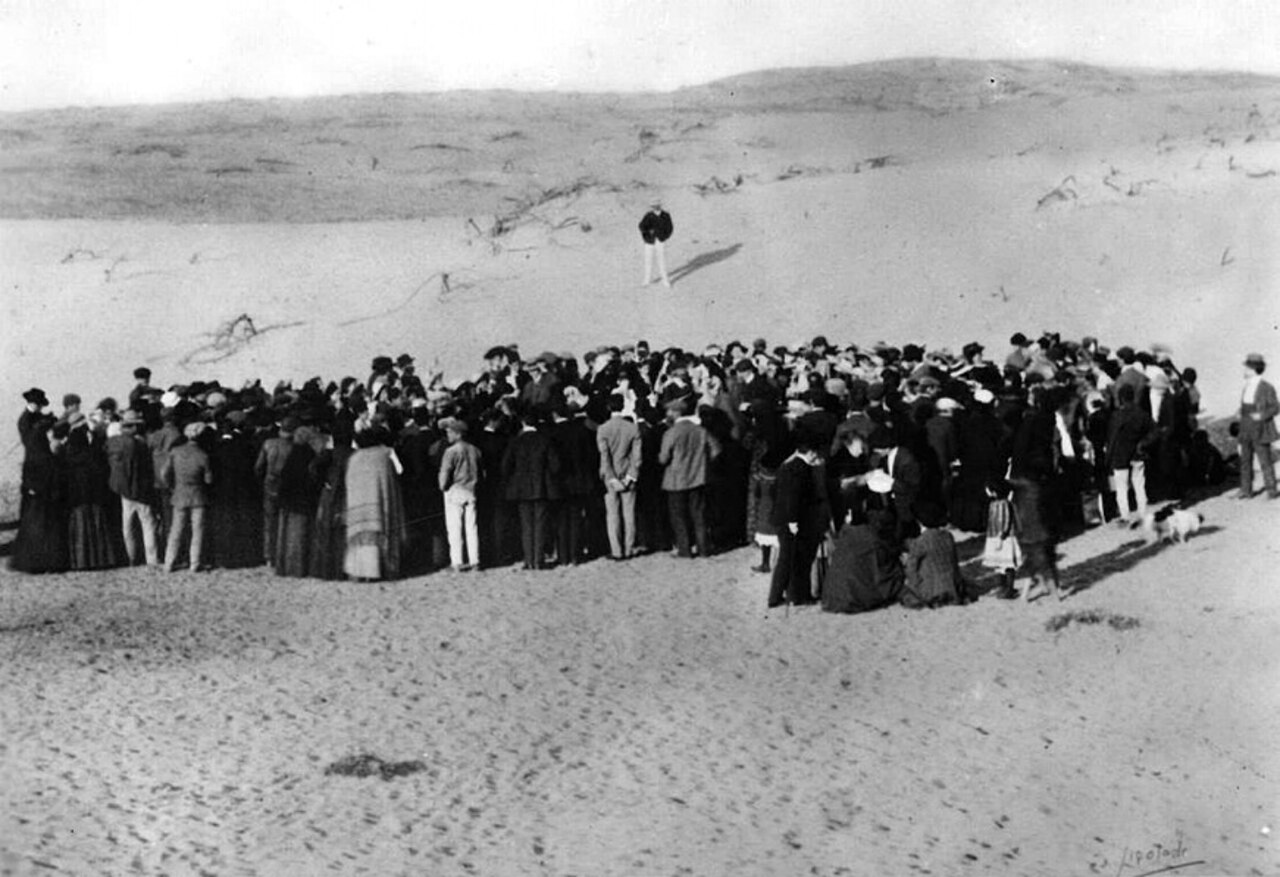
The photograph above of members drawing lots on the dunes in 1909 shows the best-known use of the word "ahuza": the Ahuzat Bayit association, founded in Jaffa in 1906, which grew into Tel Aviv. Unlike the diaspora Ahuza companies described above, its members were Jewish residents already living in Jaffa, not buyers abroad.
Because Ottoman law barred foreign Jews from registering land, the roughly sixty plots the association bought north of Jaffa were registered in the name of Jacobus Kann, a Dutch citizen and Zionist activist, acting on the members' behalf. According to a biographical account from the Dutch Jewry heritage site, the 1906 registration of one tract involved a question from the Ottoman authorities about Kann's religion, which his local representative answered inaccurately. The mismatch went unnoticed until the summer of 1909, when association members began building on their plots and local officials realised they had been misinformed. The dispute reached Constantinople before the Dutch Ministry of Foreign Affairs intervened on Kann's behalf as a Dutch citizen; Kann then transferred the plots to the association's members.
The episode is a reminder for families researching this period: land bought for Jews abroad, or through a foreign citizen acting on their behalf, sometimes ended up registered under a name that does not look Jewish or local at all.
What records might exist today?
- The Central Zionist Archives, Jerusalem. Katz's research rests on correspondence between Ahuza companies and the Palestine Land Development Company held there, including files on the Winnipeg, Toronto and Montreal companies. Records of other companies may be held there too.
- Land registers. Where Ahuza land was registered, in a company's name or later in individual members' names, entries may appear in the Mandate-era registers and in today's Israeli land registry (the Tabu).
- Contemporary press. The JTA and Jewish newspapers reported on Ahuza meetings, purchases and officers.
- Family papers. Share certificates, instalment receipts, membership books or letters bearing the name of a city's Ahuza are valuable starting points. Our guide to documents at home that can prove a land purchase explains what to look for.
A record of membership is not proof that a particular plot exists or still belongs to the family. Land may have been sold, divided, transferred or never bought at all. Property and inheritance law in Israel is complex and can change, so families who find documents should seek advice from a qualified Israeli lawyer.
Where to start
If your family remembers a grandfather who "paid for land in Palestine" through a society in his city, start by writing down his name, his city and any dates or document names you have. Our guide on how to find out whether a great-grandfather bought land in Israel sets out the next steps.
Jewish Lost Assets is a small Israel-based team that searches records of land bought between the 1920s and the 1950s by Jewish buyers living abroad. You can send us an inquiry. The first search is free of charge. If we find relevant documents, the family receives a preliminary summary and a clear quote and then decides. If we find nothing, there is no fee.
Not ready to send an inquiry? Start with our free Family Land Research Kit (PDF): what to gather at home, where each kind of record is kept, and the words you will meet in old deeds.
Questions families ask
What does Ahuza mean?
It is a Hebrew word that the historian Yossi Katz translates as ownership of private land. He notes that the name is taken from the Book of Numbers (32:22).
Which town was founded by an Ahuza society from New York?
Ra'anana. Encyclopaedia Judaica states that it was established in 1922 as a moshava by American Jews of Ahuzat New York A Inc., a company formed in 1912.
Did every Ahuza member receive a plot?
Not necessarily. In the plans studied by historians, land was bought and worked jointly, and individual plots were divided by lot only when members arrived to settle. Many companies also dissolved before buying any land.
My grandfather paid into an Ahuza but never emigrated. Could there be a record?
Possibly. The Central Zionist Archives holds correspondence of several Ahuza companies, and land that was registered appears in Mandate-era and Israeli land registers. Only a search of the records can show what happened in a particular case.
Why might an old land document show a non-Jewish or foreign name?
Ottoman law sometimes barred Jews from registering land directly, so a purchase was occasionally registered in the name of a foreign citizen acting on the buyers' behalf, as happened when the Dutch citizen Jacobus Kann registered land for the Jaffa association that became Tel Aviv. A name that does not look Jewish does not rule out a family connection.
Sources
- The Plan and Efforts of the Jews of Winnipeg to Purchase Land and to Establish an Agricultural Settlement in Palestine before World War One — Yossi Katz, Canadian Jewish Historical Society Journal — The Achoozo system, 70 companies, five settlements, membership terms, Winnipeg company, CZA files
- Ra'anannah — Encyclopaedia Judaica, via Jewish Virtual Library — Founded 1922 by American Jews of Ahuzat New York A Inc. (1912); land bought through the Palestine Land Development Company
- Achooza Now Owns 25,000 Dunams of Palestine Land — Jewish Telegraphic Agency, 3 October 1930 — New York Achooza Aleph holdings, Yavneh purchase, settlers' bank
- Poriyyah — Encyclopaedia Judaica (Efraim Orni), via Encyclopedia.com — Fruit farm founded by American Zionists; abandoned during the First World War
- Treasure Trove recalls an early plan to buy land in the future State of Israel — The Canadian Jewish News, 2026 — Achooza companies in North American cities
- Ra'anana: five score and two years ago — The Jerusalem Post, 20 March 2014 — Ra'anana once known as Little America
- Cautions Jews on Absentee Land Holding — Jewish Telegraphic Agency, 9 July 1935 — American owners who bought land but could not live there
- Afula: History — Afula Municipality — Polish buyers of land who perished in the Holocaust
- Jacobus Henricus Kann — Dutch Jewry — Kann's 1906 registration of Ahuzat Bayit's plots in his own Dutch name, the 1909 dispute over his religion, and the Dutch Ministry of Foreign Affairs' intervention
This guide is general historical information, not legal advice. Every family's case depends on the specific records found.